
Voltage drop calculator — does your cable pass?
Enter the current, the one-way length and the cross-section; Lastsocket returns the drop in volts and percent and a PASS or FAIL against the limit in your pack: 3 % for lighting and 5 % for other circuits on a public supply (6 % and 8 % on a private one) under BS 7671. Pick another pack and the limit and the rule cited change with it.
Limits and citations come from the app's pack files. The calculator below is checked against the app's engine on every build · engine 1.
voltage drop 6.2 percent, fail, limit 5 percent other
Working
- Resistance
- r₂₀ = 7.410 Ω/km · Copper 2.5 mm² · IEC 60228 max DC
- Temperature
- θ = 70 °C (PVC 70 °C operating) · α = 0.00393 /K · rθ = 8.866 mΩ/m
- Formula
- ΔU = 2 · I · L · rθ · cos φ
- Numbers
- 2.000 · 16.00 A · 50.0 m · 8.866 mΩ/m · 1.00 = 14.186 V
- Percent
- 14.186 / 230 = 6.17 % · limit 5 % · BS 7671 (UK / IE) pack
- Not checked
- Iz · short-circuit · Zs / disconnection time
- Engine
- 1
Design aid. Verify against your installation standard and manufacturer data.
Same numbers. Offline. In your pocket.
In the app, one tap tries the next size.
The app does this in the van with no signal, keeps your last five jobs, and sizes the cable for you with Iz and voltage drop together.
Finding the smallest size for you is Pro. What Pro unlocks
Checked against the app's engine on every build · engine 1
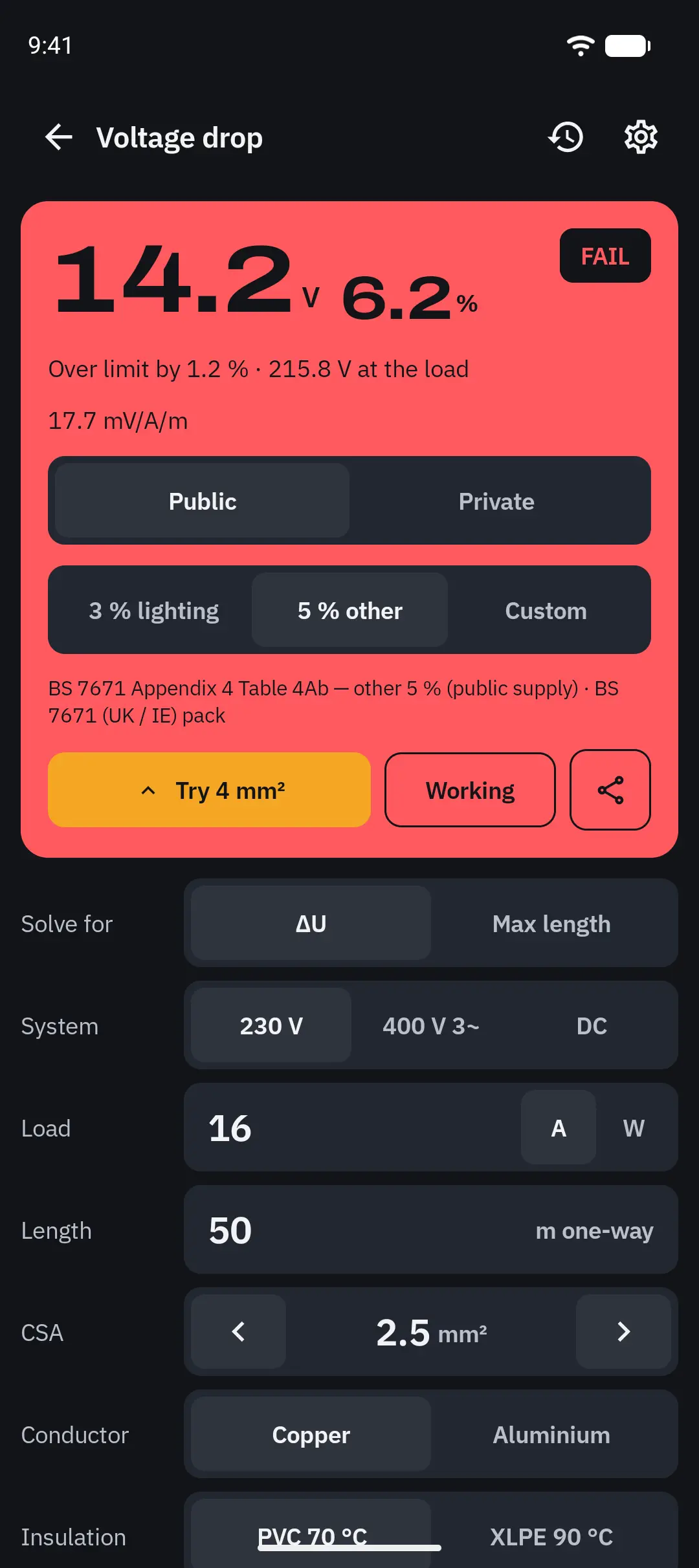
The same job in the app
16 A over 50 m on 2.5 mm² copper: 14.2 V, 6.2 % — FAIL at 5 %. One tap tries the next size. Works with no signal, remembers your last job, and sizes the cable with Iz and voltage drop together.
How it's calculated
Single-phase: ΔU = 2 · I · L · rθ · cos φ. Three-phase (line-to-line): ΔU = √3 · I · L · rθ · cos φ. DC: ΔU = 2 · I · L · rθ.
The resistance rθ is the IEC 60228 maximum DC resistance for the cross-section, corrected to the conductor’s operating temperature — 70 °C for PVC, 90 °C for XLPE — with rθ = r20 · (1 + α(θ − 20)) and α = 0.00393 /K for copper. This matters: a calculator that uses 20 °C under-reads the drop by about 20 % and will pass cables that fail. From 16 mm² reactance is included. On the BS 7671 pack the familiar mV/A/m figure is shown, derived from the same resistance.
Solve for length
Switch “Solve for” to Max length and the same formula runs backwards: with 16 A on 2.5 mm² at 5 % you can go 40.5 m one way.
Worked example
| System | 230 V single-phase |
|---|---|
| Load | 16 A |
| Length, one way | 50 m |
| Cross-section | 2.5 mm² copper, PVC at 70 °C |
| Limit | BS 7671 Appendix 4 Table 4Ab — other 5 % (public supply) |
r20 for 2.5 mm² is 7.41 Ω/km; at 70 °C that is 8.87 mΩ/m. ΔU = 2 × 16 × 50 × 0.00887 = 14.19 V, which is 6.17 % of 230 V. FAIL at 5 %, over by 1.2 %, with 215.8 V at the load. One size up, 4 mm², comes to 3.8 %. The app's working card shows exactly this.
More from this screen
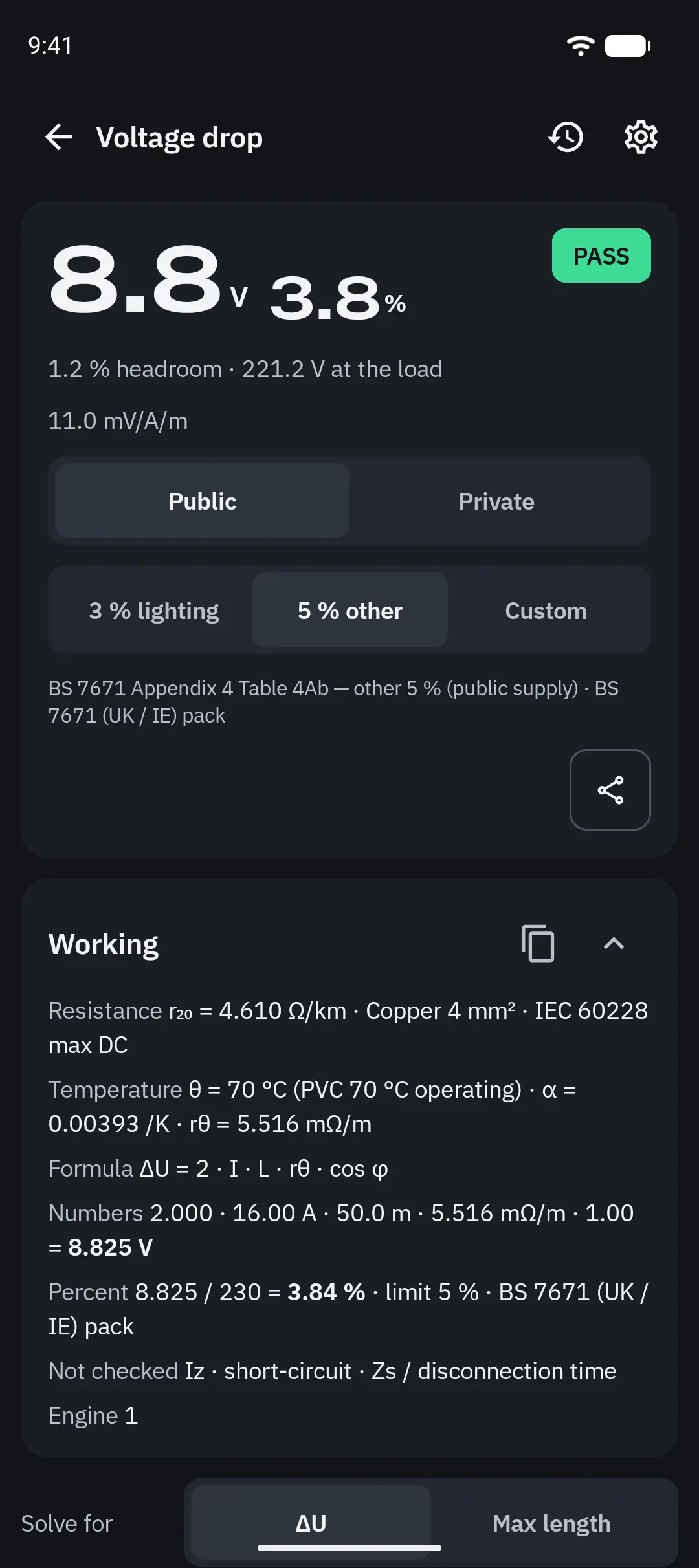
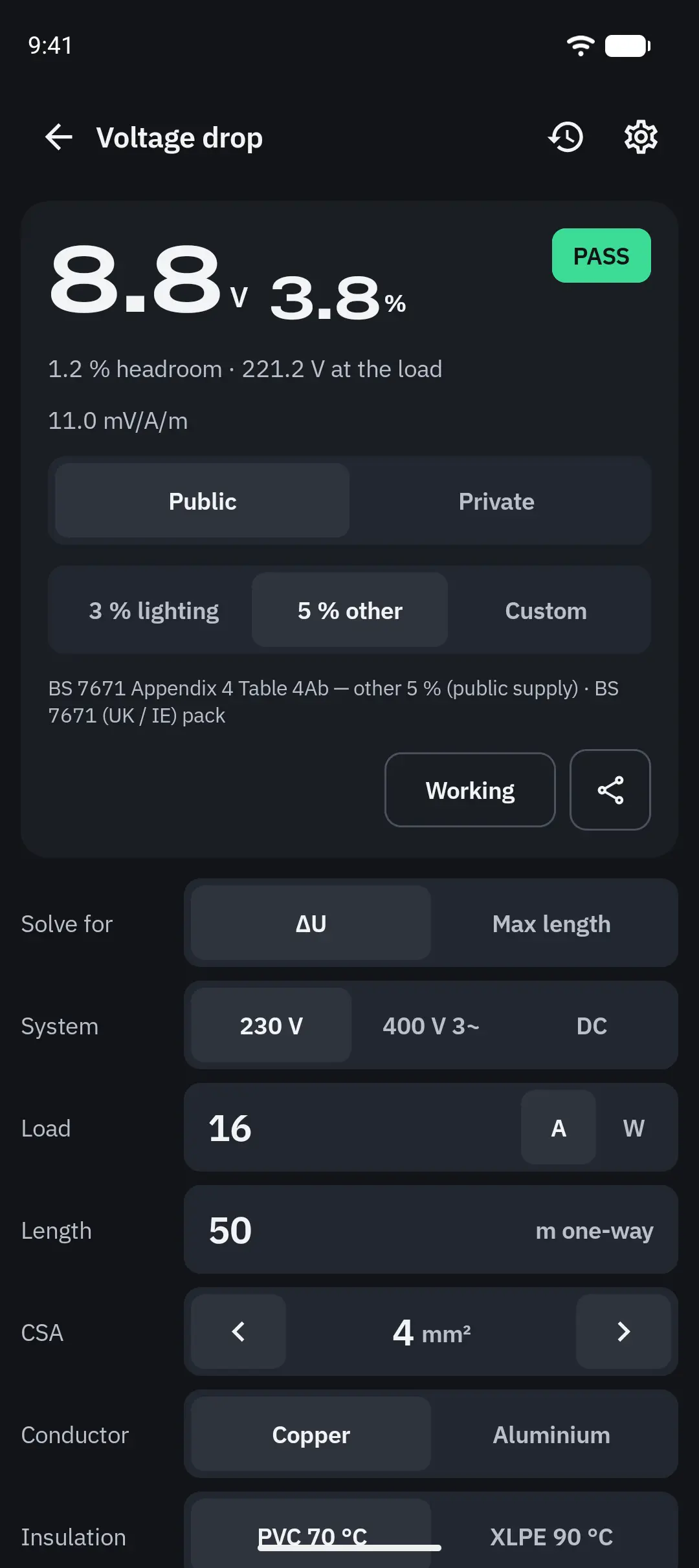
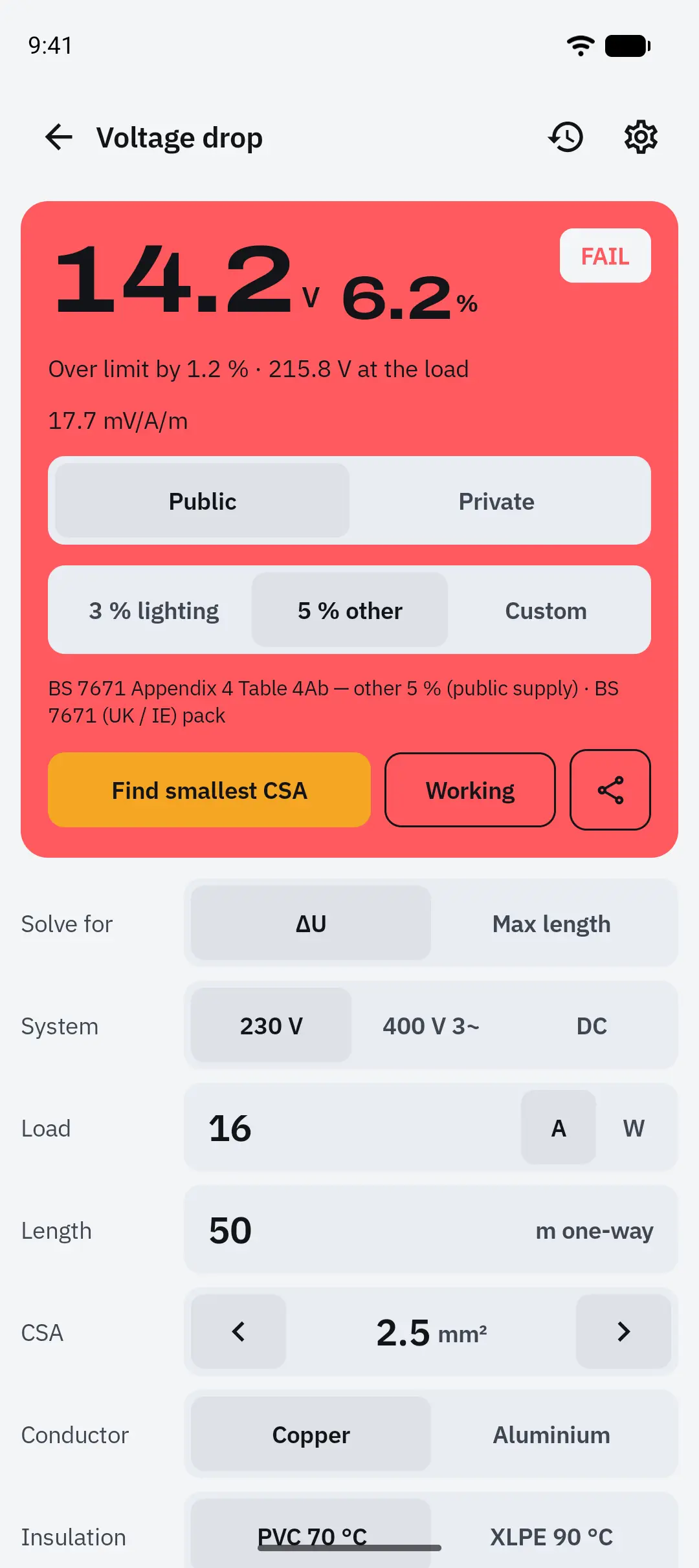
Questions
Why 70 °C and not 20 °C?
A loaded cable runs hot; the standards' tables assume operating temperature, so the drop must too.
Which limit applies?
It depends on the standard you work to. 3 % for lighting and 5 % for other circuits under IEC typical, NEN 1010 and NF C 15-100; 3 % for lighting and 5 % for other circuits on a public supply (6 % and 8 % on a private one) under BS 7671; 3 % for every circuit under DIN VDE 0100. Your pack sets it, and you can type a custom limit.
Does the length include the return?
No — enter the one-way length; the formula doubles it for single-phase and DC.
Is 3 % realistic at 12 V?
Rarely: 3 % of 12 V is 0.36 V. Use the DC drop mode and expect to go big or go short.