
Pipe size by velocity — inner diameter, not nominal
di = √(4Q / πv). Enter the flow and the velocity you will accept; type your pipe's inner diameter to see its actual velocity, or let Pro pick the next catalogue size. The pick is by inner diameter — 22 × 1.0 copper is 20 mm inside, and that matters.
Limits and citations come from the app's pack files. The calculator below is checked against the app's engine on every build · engine 1.
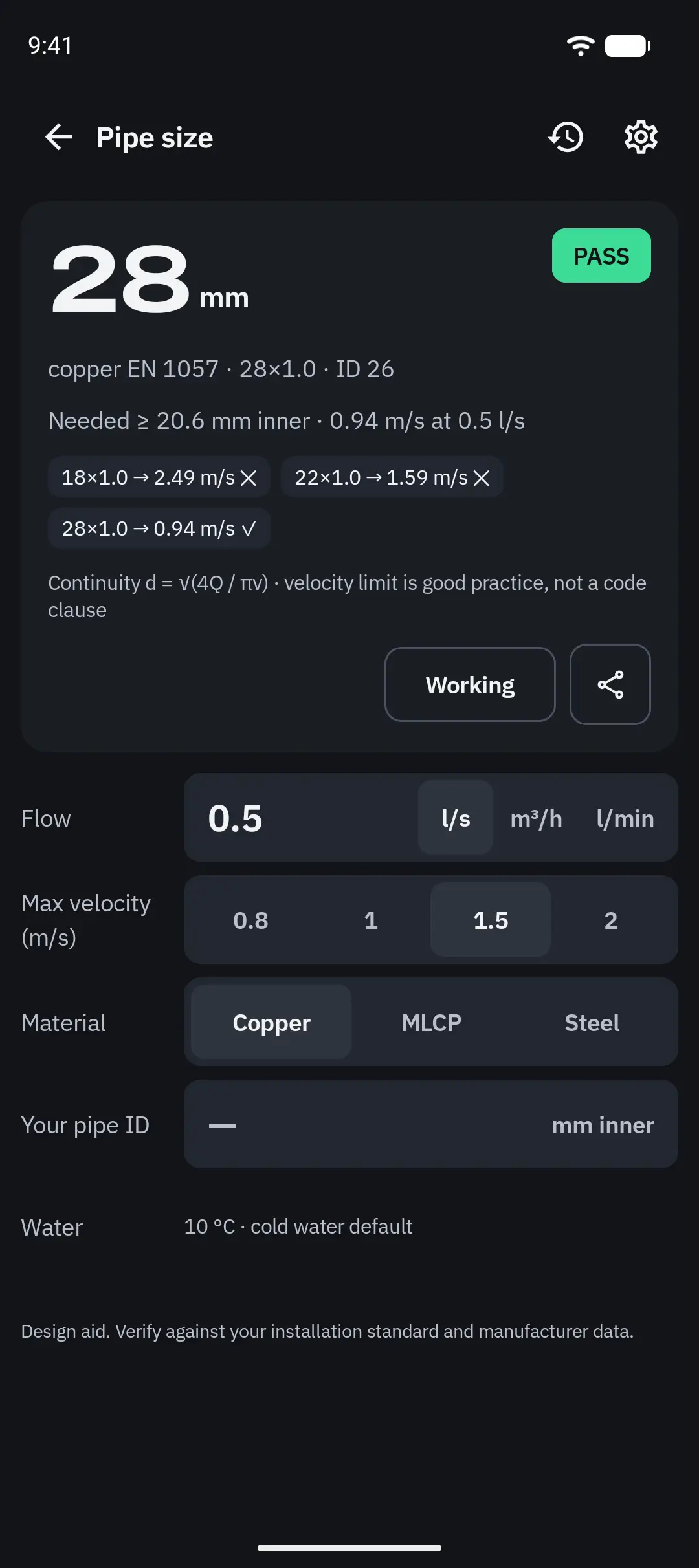
The same job in the app
0.5 l/s at 1.5 m/s needs 20.6 mm inside: 22×1.0 runs at 1.59 m/s, so the pick is 28×1.0 at 0.94 m/s.
How it's calculated
Continuity: the flow Q is the velocity v times the bore area, so the smallest bore that keeps the water under your velocity is di = √(4Q / πv).
The decision that matters on this page is which diameter gets compared. A pipe is sold by its outside diameter and wall, and the water only sees the inside. The app compares the required bore against the catalogue’s inner diameter and shows the size it rejected and the velocity that size would run at.
Worked example
0.5 l/s is 0.0005 m³/s; at 1.5 m/s, di = √(4 × 0.0005 / (π × 1.5)) = 20.6 mm. A 20 mm bore (22×1.0 copper) runs at 1.59 m/s; a 26 mm bore (28×1.0) at 0.94 m/s.