
Pressure loss in a pipe run (Darcy-Weisbach)
Δp = f · (L/d) · ρv²/2, with the friction factor from Swamee–Jain and roughness by material. Fittings are added as equivalent length: 0.5 m per elbow and 1.0 m per tee.
Limits and citations come from the app's pack files. The calculator below is checked against the app's engine on every build · engine 1.
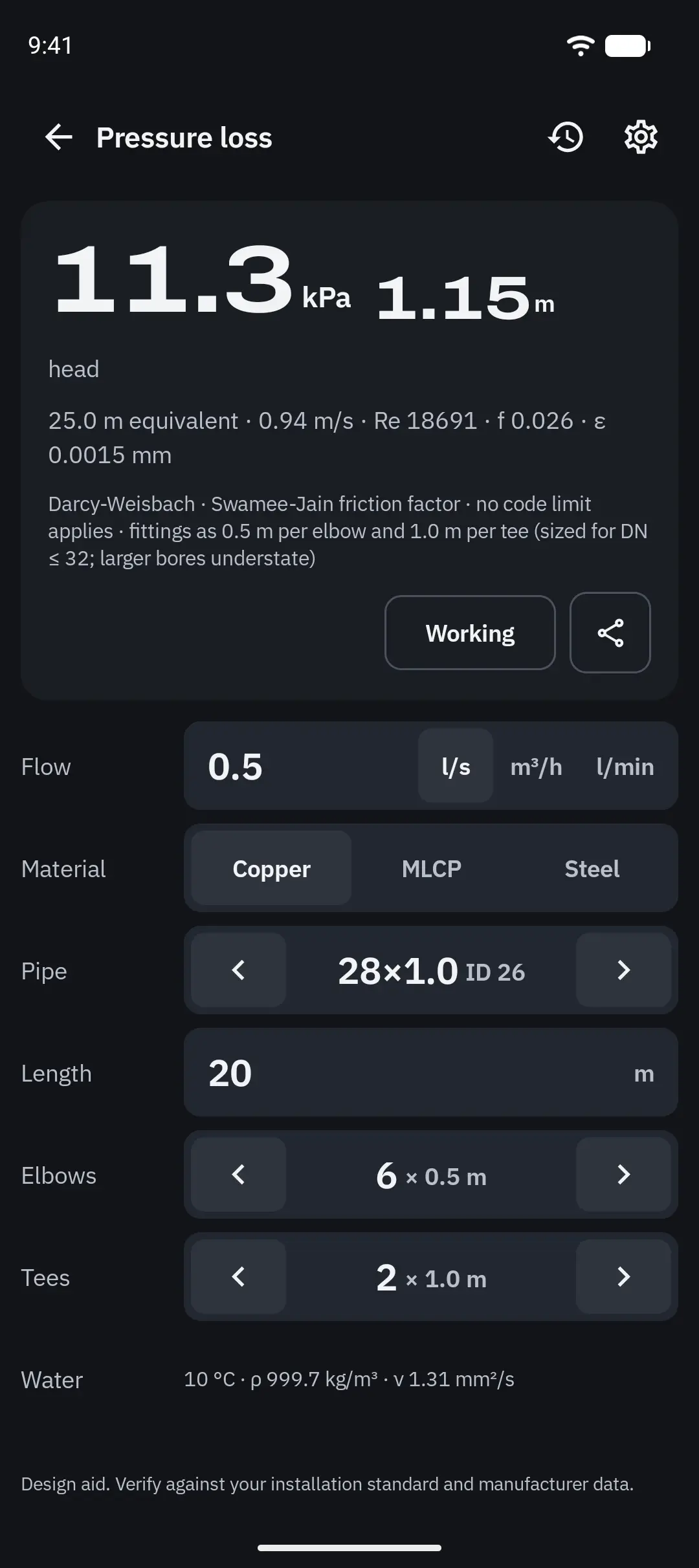
The same job in the app
0.5 l/s through 20 m of 26 mm copper with 6 elbows and 2 tees: 11.3 kPa, 1.15 m head.
How it's calculated
Darcy-Weisbach: Δp = f · (L/d) · ρv²/2. The velocity comes from the flow and the inner diameter; the friction factor f comes from the Swamee–Jain formula, which needs the Reynolds number and the pipe’s roughness. Water is taken at 10 °C.
Elbows and tees are counted as extra pipe — an equivalent length added to the run before the formula is applied. The result is shown in kPa and in metres head, with the Reynolds number and friction factor in the working.
Worked example
0.5 l/s through 20 m of 26 mm copper with 6 elbows and 2 tees: the fittings make it 25 m equivalent, the water moves at 0.94 m/s, and the loss is 11.3 kPa — 1.15 m head.